
By Rachel Ledoux
I was twelve years old when I realized I was queer. Not long after that, I became an activist.
At the time, I certainly would not have described myself that way. I was a kid in rural Vermont who was still figuring out what being queer meant for me, let alone what I could possibly do for the broader LGBTQ+ community. But as I started learning more about LGBTQ+ issues, I also began to understand how many of the challenges facing our community were bigger than any one person. I wanted to be part of changing them.
In high school, I found one of my first opportunities to do that through Outright Vermont, where I served two terms as a Youth Organizing Fellow. It was my introduction to grassroots organizing and, in many ways, the experience that paved the way for nearly everything I have done since. I learned how to organize around an issue, talk to people who did not necessarily share my perspective, and work alongside other young people who cared deeply about making our communities better.
Most importantly, I learned that young people belong in these conversations.
I also started to discover another way I could contribute: writing. I have always loved to write, but as I became more involved in advocacy, I realized that communications could be a form of activism in its own right. A policy can be incredibly important, but if the people it affects do not understand what it does – or never hear about it in the first place – its impact can feel very far away. I became interested in finding the human stories behind complicated issues and making policy feel accessible to the people whose lives it shapes.
That interest has taken my work in directions that twelve-year-old me probably never could have predicted.
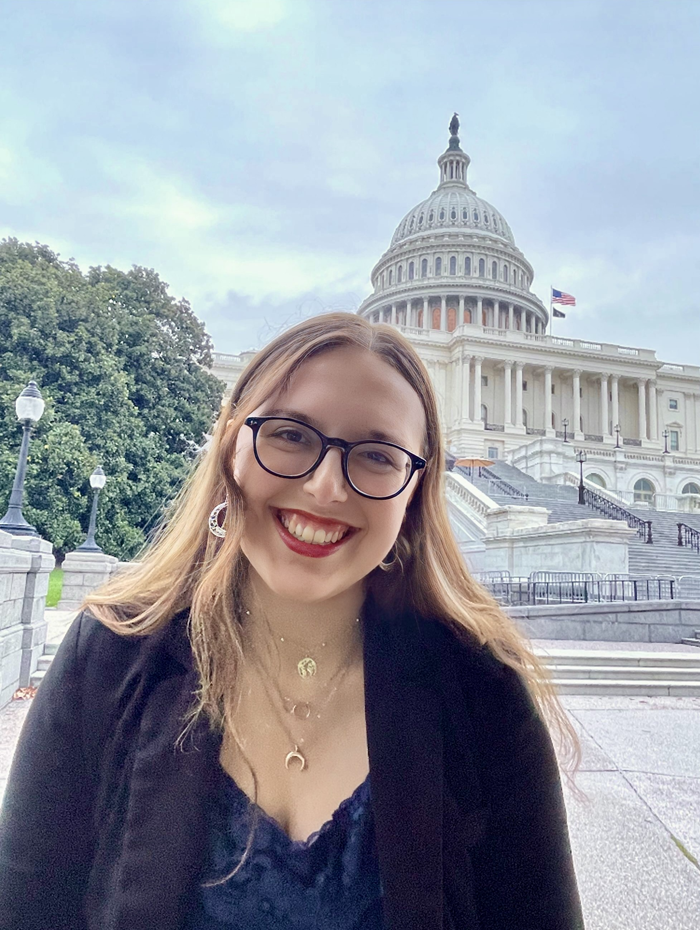
Now, I am an honors student at Simmons University studying Political Science and Economics, with minors in Public Policy, International Relations, and Law & Justice. Much of my work now focuses on democracy, education, youth civic engagement, and policy communications. On the surface, not all of that looks like LGBTQ+ activism. But I’ve never really viewed these parts of my work as separate.
As an Education Research Fellow with the Education Justice Academy, I had the opportunity to research youth housing insecurity and think about ways policymakers can better support young people experiencing homelessness. That work deepened my understanding that LGBTQ+ advocacy does not exist in a separate policy bubble. Housing, education, and access to government and political power are all LGBTQ+ issues. So is ensuring that young people understand the systems shaping their lives and feel empowered to change them.
Some of the most meaningful moments, though, have happened much closer to home. At Simmons, I helped lead an Honors service-learning project supporting BAGLY, the Boston Alliance of Gay, Lesbian, Bisexual and Transgender Youth. We collected more than 75 items through a clothing drive and organized a panel focused on LGBTQ+ youth homelessness. Getting to bring that conversation onto my own campus felt like a return to where my activism started: young LGBTQ+ people sharing their experiences, being taken seriously, and helping others understand what needs to change.
My understanding of activism has expanded a lot since I was twelve. I used to think being an activist meant doing something obviously recognizable as activism – organizing a campaign, attending a protest, or speaking in front of a crowd. Sometimes it does. But I have also learned that it can mean researching a government budget, writing an article, mentoring another young person, organizing a clothing drive, or explaining a complicated policy in a way that helps someone realize why it matters to them.
That is one reason being part of SpeakOUT has meant so much to me. SpeakOUT is built around an idea I have gradually come to understand throughout my own work: our stories have power.
I have been incredibly fortunate to receive the SpeakOUT Student Scholarship twice. The financial support has made a real difference as I work my way through college, but the meaning of those awards has gone beyond the scholarship itself. They have helped me continue an education that I hope to spend in service of others, while reminding me that there is a community of people who believe young LGBTQ+ voices are worth investing in.
I am equally honored to now be part of SpeakOUT's volunteer network and community. There is something especially meaningful about joining an organization that treats sharing our experiences not as an addition to advocacy, but as advocacy itself.
More than eight years after I first began figuring out who I was and how I could help, I am still figuring out exactly where this work will take me. My interests have grown, and the work I do looks different than it did when I started.
But one thing has remained remarkably consistent: I want young people, especially LGBTQ+ young people, to understand that their experiences matter, that the decisions being made around them are not beyond their reach, and that they have something valuable to contribute.
I was lucky enough to learn that lesson early. Now, I hope I can help other young people learn it, too.
Rachel Ledoux received a SpeakOUT scholarship in 2025 and 2026. For more information about the program, visit our website. The deadline for the 2027 application cycle will be announced in January.