
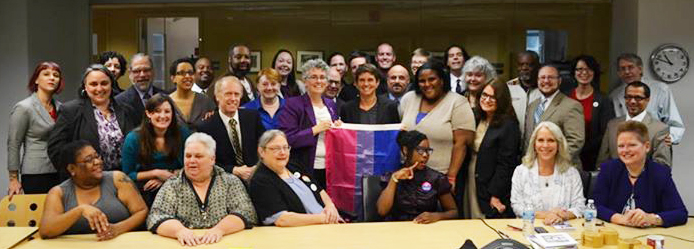
Bisexual leaders from across the country met at the National LGBTQ Task Force offices before the first White House Roundtable on Bisexual Issues at the White House. Ellyn Ruthstrom is holding the left side of the bisexual flag.
Each year, as Bi+ Health Awareness Month (BHAM) comes around, I feel a deep sense of pride. Since its founding in 2014, the bi+ community has sustained this vital campaign and made it a meaningful part of its annual calendar. My connection is personal—I helped create BHAM during my time as President of the Bisexual Resource Center. The idea began to take shape after I co-organized the first White House Roundtable on Bisexual Issues with the Obama Administration in September 2013. A team of 34 bi+ activists from across the country presented information about physical and mental health issues (including HIV/AIDS), partner violence, hate crimes, and workplace discrimination, bringing both statistics as well as real-life experiences to the table.
That experience was a wake-up call. For decades, research had grouped gay, lesbian, and bi+ people together, obscuring important differences. Once data began to be separated out, the disparities became clear: bi+ people face higher rates of depression, suicidality, cancer, tobacco use, partner violence, and poverty, among other challenges. Yet despite these heightened risks, services and programs were rarely designed specifically with bi+ people in mind. In fact, our inclusion often amplified broader LGBTQ+ statistics without translating into targeted support.
The experience of presenting this information in a high-level forum gave me hope that we could make a difference, and I came back to Boston energized to do more with the information and to reach more people. Fortunately, the BRC had a wonderful intern at that time, Jules Canfield, who drafted a proposal as part of their coursework at Boston University that became the blueprint for Bisexual Health Awareness Month. Together, we worked to design social media materials and mobilize organizations and individuals nationwide to participate in the inaugural campaign with its first theme: Bi the Way, Our Health Matters Too!
This year, the theme Claiming the Right to Care as Bi+ People emphasizes that bi+ people are entitled to competent, affirming, and accessible healthcare without having to justify their identities, minimize their needs, or accept inadequate treatment. As the largest segment of the LGBTQ+ community, bi+ people deserve to have our health and our lives fully valued. The BRC is sponsoring two upcoming online events on March 24 and 31 to explore self-advocacy in healthcare and how providers can create more supportive, inclusive experiences.
It’s inspiring to see how BHAM has grown into an annual space for education, visibility, and connection. Seeing the wide range of supporters on the BiHealthMonth.org landing page reminds me how many dedicated activists continue to sustain and evolve this work. Their energy and commitment ensure that this awareness month remains relevant and impactful.
Ellyn Ruthstrom was the president of the Bisexual Resource Center for ten years and has been involved with bi+ organizing for over 35 years. She is the Executive Director of SpeakOUT Boston and the Project Director for the Visibility Impact Fund.